The color science most of us know is only the tip of a very large iceberg. ΔE metrics are based on XYZ, which is based on the color matching functions, which are based on our visual system and the spectral properties of light, which take us to the physics of light.
But depending on how we want to understand what “color” means, this is only a small part of something much bigger.
Even if we limit ourselves only to human perception, there is a whole world waiting to be unveiled.
Take, for example, chimerical colors.
Many of you probably already know them. For those who do not, I am going to show you colors you have never seen before. No, I am not going to point any laser at your eye, and I am not going to show you a material so black that it gets close to a perfect absorber either.
Chimerical colors are obtained by cheating a little, by “tiring” our cones. They were described by Paul Churchland in a paper on cognitive neuroscience in 2005.
The paper is dense and deals with the Hurvich–Jameson (H–J) opponent-process network, which is too technical to discuss here, but it describes a really beautiful experiment.
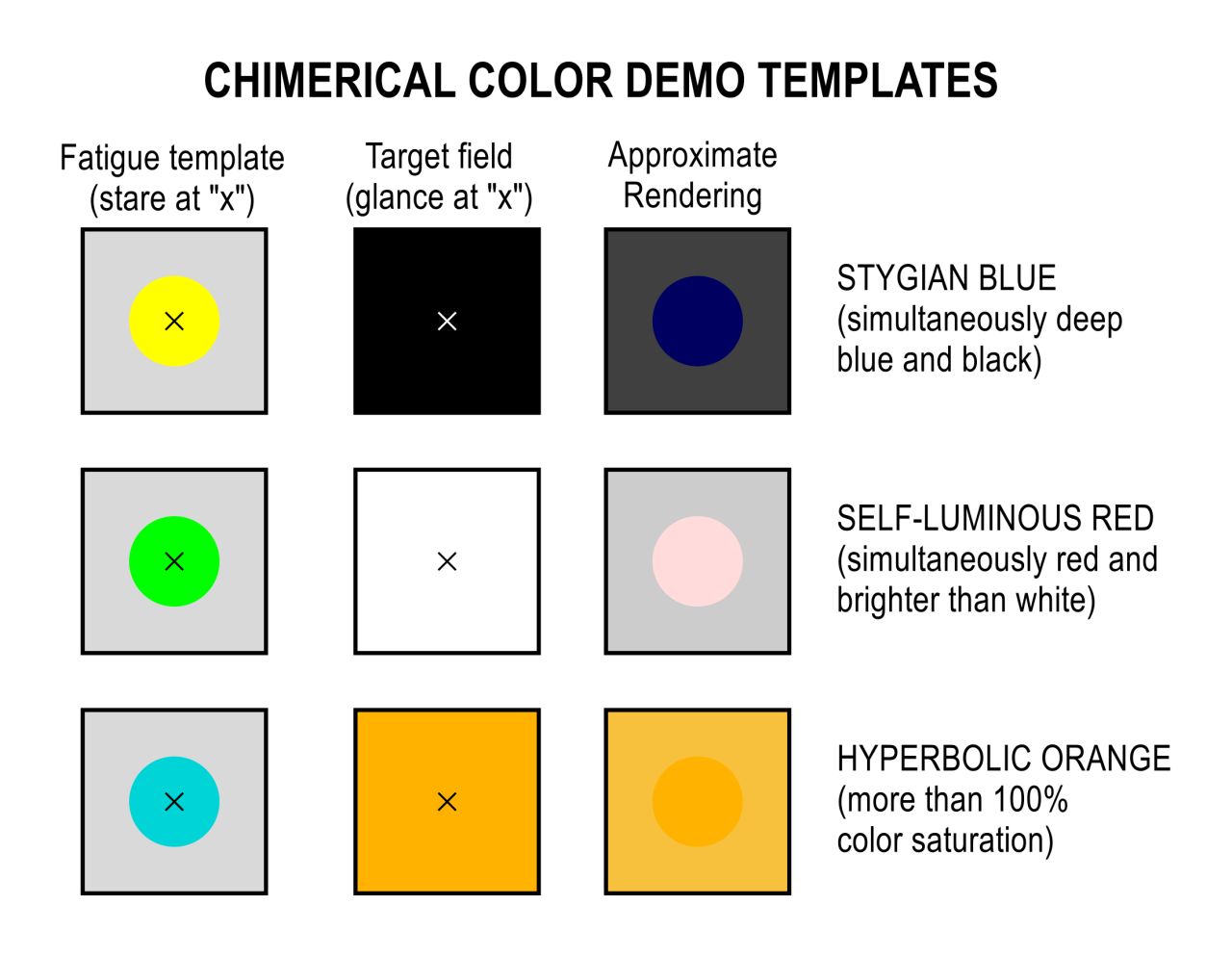
In this image there are three types of chimerical colors: hyperbolic, Stygian and self-luminous.
The image was created by the user “Zowie” and can be found on the English Wikipedia, CC BY-SA 3.0. “Zowie” was actually Dr. Craig DeForest, a solar astrophysicist at the Southwest Research Institute (SwRI).
- Enlarge the image so that the colored circle and the fixation mark are clearly visible.
- Fix your gaze on the X at the center of the colored circle.
- Keep looking at that X for about 30 to 60 seconds, without looking around the circle.
- Then quickly move your gaze to the X in the adjacent field.
- Keep looking at that second X for a few seconds.
- You should perceive an afterimage with the corresponding chimerical color.
- Rest your eyes briefly before trying the next row.
The image on the right is only an approximation of the perceived color. The real chimerical color is produced by visual adaptation and cannot be reproduced directly on the screen.
- Stygian colors look both strongly colored and black at the same time.
- Self-luminous colors appear brighter than white, as if they were emitting light themselves.
- Hyperbolic colors appear more saturated than any normal color you can display or print.
Reference: Philosophical Psychology, vol. 18, no. 5, October 2005, pp. 527–560.