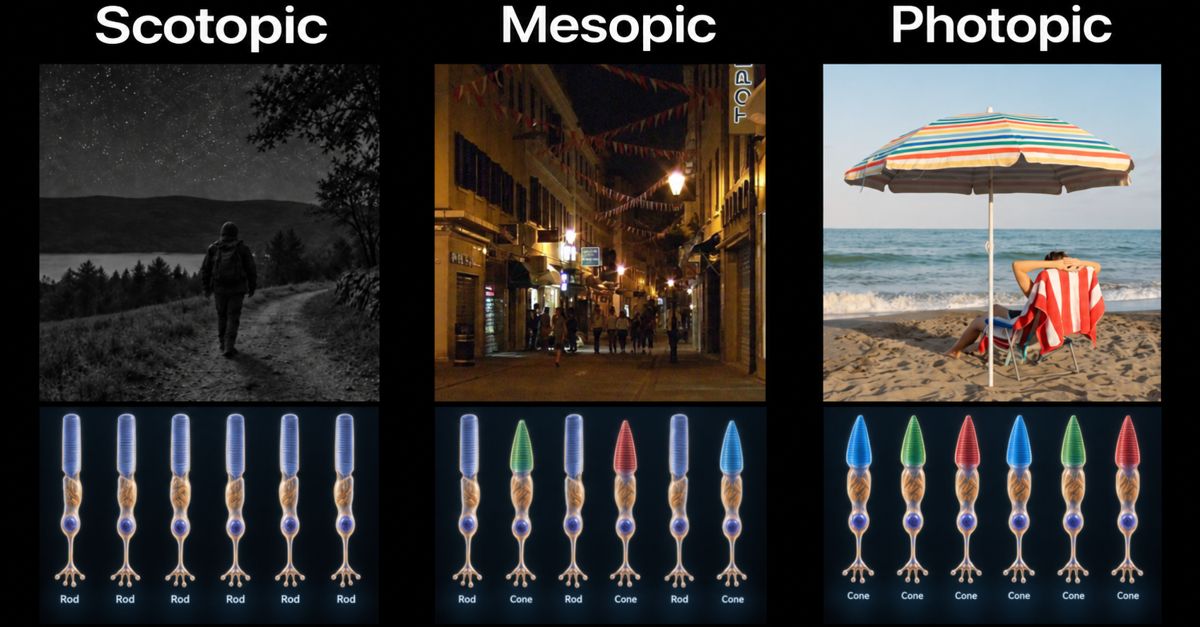
Human vision is truly amazing. One of the things that surprises me most is its adaptability.
Our eyes, the “physical” part of vision, use specialized cells to translate light into signals: cones and rods.
Cones are sensitive to different regions of the visible spectrum. Most of us have three types, L, M and S, sensitive mainly to long, medium and short wavelengths, loosely comparable to RGB. Some people may have additional cone variants, but I’ll leave that for another post.
Rods, on the other hand, are specialized much more in detecting the amount of light than its spectral composition.
All this is fairly well known. What is less well known is that cones and rods do not always work together in the same way.
There are three main regimes of human vision. They occur depending on the amount of available light and the state of visual adaptation. There is also a notable side effect: colorfulness changes with luminance.
At dimmer levels we enter the mesopic regime. Both cones and rods contribute simultaneously. We experience this at dusk, in poorly illuminated streets, or in many other dimly lit environments.
Outdoors, when you are at the beach on a sunny day for instance, vision is strongly photopic. The cones clearly dominate. Colors can appear extraordinarily vivid and saturated. Have you ever looked at photographs while sitting on a sunny beach? Don’t they sometimes seem strangely different from how they look at home?
There is an interesting detail here. When we use conventional colorimetry and rely on the standard CIE color-matching functions, we are essentially assuming photopic vision: vision dominated by the cones.
The CIE 1931 2° Standard Colorimetric Observer approximates the central foveal region of vision. The fovea is strongly dominated by cones, with few rods and practically none in the central foveola. So, the 2° observer is well suited to a cone-based description of color vision.
For the CIE 1964 10° observer the situation is even more explicit. A 10° field extends well beyond the fovea into retinal areas where rods are abundant. The CIE specifies that the 10° observer should be used at sufficiently high photopic levels and under conditions where no participation of the rod receptors is expected.
Finally, there is one last mode of vision, less familiar in modern everyday life and in some ways rather mysterious: scotopic vision.
This is vision using essentially only the rods.
Modern people seldom experience fully scotopic conditions. We are surrounded by artificial illumination. But if one night you find yourself under the stars and far away from towns, your eyes will gradually adapt to the dim illumination and then scotopic vision will begin to take over.
Everything appears almost black and white… Of course! You are relying on the rods rather than the cones.
Perhaps you have experienced it after waking up in the middle of the night, with no illumination other than a very faint light coming through the window…